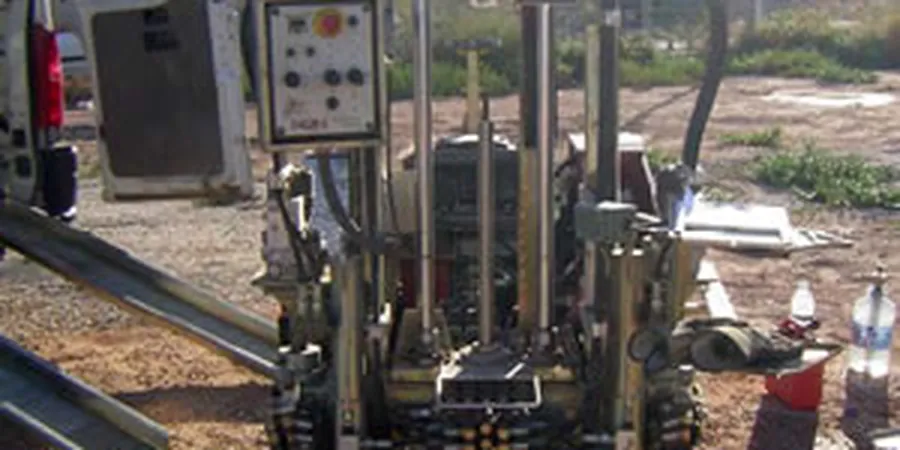
Longueuil sits at just 15 meters above sea level, on the thick, sensitive clay deposits of the St. Lawrence Lowlands. This is Champlain Sea sediment. More than 13,000 years old. And it does not forgive assumptions. We run cone penetration tests here because the stratigraphy changes fast – sometimes within 20 horizontal meters you go from stiff silty crust to soft marine clay. A CPT rig pushes a 15 cm² cone at 2 cm/s, and we read tip resistance, sleeve friction, and pore pressure every 10 mm. No sampling. No lab delay. The result is a continuous profile of soil behavior type that lets you see exactly where the weak layers sit. For projects near the river or in the Vieux-Longueuil sector, we often pair this with seismic microzonation studies to understand how the clay will respond during a seismic event.
A CPT profile reveals what a borehole log can miss: the thin, high-risk silt seams inside a Champlain clay deposit.
Frequently asked questions
What does a CPT test cost for a typical Longueuil residential lot?
For a standard residential investigation in Longueuil, a CPT program typically ranges from CA$220 to CA$330 per sounding meter, depending on depth, access, and whether you need additional dissipation tests. A single-family home lot usually requires two to three soundings.
Can CPT replace boreholes for foundation design in Champlain clay?
In many cases, yes. The CPT gives a continuous strength profile that often surpasses SPT data for soft clays. But if you need to measure sensitivity or run consolidation tests, you still need a few thin-wall Shelby tube samples. We recommend a hybrid program: CPT for profiling, with one borehole for validation samples.
How deep can you push a cone in Longueuil's soil?
It depends on the till surface. In much of central Longueuil, the Champlain clay extends 20 to 25 meters before hitting dense glacial till. Our rig can push to refusal in that till, which typically occurs when tip resistance exceeds 40 MPa. In the Saint-Hubert area, gravelly outwash can stop the cone shallower.
Do you measure pore pressure during the test?
Yes, always. Our cone is a piezocone, meaning it records pore water pressure at the u2 position (just behind the tip) continuously. This is critical in Longueuil clay because high excess pore pressure indicates low permeability and undrained behavior, which affects how you interpret tip resistance for bearing capacity.