HomeInvestigation

Investigation in Longueuil

Together, we solve the challenges of tomorrow.

LEARN MORE →

In Longueuil, geotechnical investigation is the critical first step to understand the variable subsurface conditions shaped by the Champlain Sea clay deposits and underlying glacial till. This category covers site characterization compliant with the Code de construction du Québec and CAN/CSA standards, focusing on stratigraphy, groundwater, and soil behavior. Our approach integrates precision testing like the CPT (Cone Penetration Test) to rapidly map soft clay sensitivity and detect potential bearing issues common across the South Shore region.

These investigations are mandatory for commercial, industrial, and municipal infrastructure projects prior to foundation design or excavation. For a complete geotechnical model, field data is often paired with seismic CPT for dynamic soil properties. This ensures safe development on Longueuil’s sensitive clays, mitigating risks of settlement and slope instability through a thorough, code-driven site assessment.

Available services

CPT (Cone Penetration Test)

→ Ver detalle

Anchor design in Longueuil must account for the sensitive Champlain Sea clays that underlie much of the city’s 170,000-resident territory. These post-glacial deposits, particularly east of the Saint-Lambert boundary, exhibit thixotropic behavior that can complicate load transfer in both active and passive systems. The National Building Code of Canada (NBCC 2020) classifies portions of the South Shore as Site Class D or E, requiring rigorous verification of bond lengths in the marine silt. Our approach integrates site-specific triaxial testing to define effective stress parameters for the grout-soil interface, ensuring the tieback capacity calculations match the actual stratigraphy encountered in Longueuil’s variable overburden.

Anchor capacity in Champlain Sea clay depends more on grout injection control than on steel tendon grade—hydrofracture prevention is the real design limit.

Methodology and scope

The anchor installation in Longueuil typically employs rotary duplex drilling with a casing advancement system to prevent borehole collapse in the soft clay matrix. A high-strength Dywidag bar or multi-strand tendon is placed inside a corrugated HDPE sheath, with controlled grout injection pressures kept below 500 kPa to avoid hydrofracturing the sensitive clay structure. For temporary excavation support along Taschereau Boulevard, we often specify an unbonded length extending at least 2 m beyond the critical failure surface defined by limit equilibrium analyses. The bonded portion is sized using the effective stress method, with a grout-to-ground adhesion factor calibrated against local CPT test profiles and vane shear data—a method that has proven reliable across multiple Longueuil infrastructure projects where the undrained shear strength can drop below 30 kPa in the upper 5 m.
Active and Passive Anchor Design for Longueuil Soil Conditions
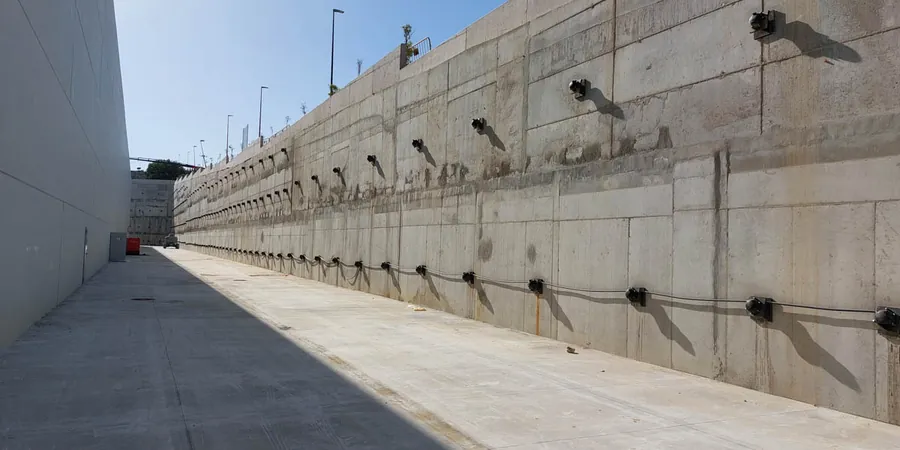
Technical reference image — Longueuil

Local considerations

Longueuil sits on the northeastern flank of the St. Lawrence Lowlands, where the Champlain Sea deposited up to 60 m of compressible silty clay that retains high sensitivity ratings—often exceeding 30 in the quick clay zones near the Richelieu River corridor. Anchor design here cannot rely solely on empirical SPT correlations borrowed from Ontario tills. The primary risk is progressive creep under sustained load, a phenomenon observed in Longueuil’s deeper excavations where passive anchors in clay can lose up to 12% of lock-off tension within the first 90 days. Seismic considerations under NBCC 2020 amplify this concern: the 1-in-2,475-year ground motion for Longueuil (Sa 0.2 = 0.62 g on Site Class C) requires evaluating anchor ductility under cyclic degradation. A slope stability analysis coupled with the anchor design identifies whether a global failure mechanism could bypass the anchored zone entirely—a scenario that conventional tieback software may miss in stratified Champlain Sea deposits.

Need a geotechnical assessment?

Reply within 24h.

Email: contact@geotechnical-engineering.org

Technical parameters

ParameterTypical value
Minimum unbonded length4.5 m or H/5 (CSA A23.3)
Typical bonded length in clay6 to 12 m (effective stress design)
Grout cube strength at 7 days35 MPa minimum (ASTM C109)
Tendon steel grade1,030 to 1,860 MPa (ASTM A416)
Lock-off load (% of design)70% for temporary, 100% for permanent
Corrosion protection (permanent)Class II (PTI DC-35 double encapsulation)
Proof test loading133% of design load (CSA A23.3 Annex D)

Associated technical services

01

Temporary Excavation Anchors

Active prestressed tiebacks designed for 12- to 24-month service life in Longueuil clay, with load cells installed at 10% of anchor locations to monitor relaxation trends during the construction window.

02

Permanent Soil Anchors

Double-encapsulated passive and active anchors for retaining walls and bridge abutments, complying with PTI DC-35 Class II protection and sized for NBCC 2020 seismic load combinations.

03

Anchor Proof Testing and Verification

On-site performance and creep testing per CSA A23.3 Annex D, with extended-duration hold tests (up to 60 minutes) in sensitive clay zones to detect long-term displacement trends before lock-off.

Applicable standards

NBCC 2020 (National Building Code of Canada), CSA A23.3:2019 (Design of Concrete Structures, Annex D), PTI DC-35 (Post-Tensioning Institute, Recommendations for Prestressed Rock and Soil Anchors), ASTM A416 / A416M (Steel Strand for Prestressed Concrete), CAN/CSA-A3000 (Cementitious Materials Compendium)

Frequently asked questions

What distinguishes active from passive anchors in Longueuil clay?

Active anchors are prestressed to a lock-off load—typically 70% of the design load for temporary works—which immediately engages the bonded length and limits wall deflection. Passive anchors develop resistance only as the structure moves, making them less suitable for sensitive Champlain Sea clay where even 25 mm of displacement can trigger progressive failure. In Longueuil, we specify active systems for most urban excavations adjacent to existing infrastructure, while passive anchors may be adequate for rock socket applications in the underlying shale of the Nicolet Formation.

Which standard governs anchor testing in Quebec?

CSA A23.3:2019 Annex D provides the mandatory testing protocol for soil and rock anchors in Canada. This includes proof testing at 133% of the design load, creep testing with incremental loading and a 60-minute hold period, and performance testing on sacrificial anchors. For permanent anchors in Longueuil, the PTI DC-35 recommendations add requirements for encapsulated tendon corrosion protection and lift-off testing at regular intervals after lock-off.

How is anchor bond length calculated in Champlain Sea deposits?

Bond length in Longueuil clay is determined using the effective stress method, where the ultimate bond stress is a function of the average effective overburden pressure, the grout-to-ground friction angle, and a soil adhesion factor calibrated to local CPT and vane shear data. A typical design bond stress in stiff Champlain clay ranges from 40 to 70 kPa. The calculation also applies a factor of safety of 2.0 to 2.5 on the grout-ground interface, as required by CSA A23.3.

What does anchor design and testing cost in Longueuil?

Anchor design and proof testing services in Longueuil typically range from CA$1.260 to CA$4.690 depending on anchor type, tendon capacity, and whether the project requires sacrificial performance testing. Temporary tieback design with standard proof testing falls at the lower end, while permanent double-encapsulated anchors with extended creep monitoring and lift-off verification represent the upper range.
Location and service area

We serve projects across Longueuil and its metropolitan area.

View larger map