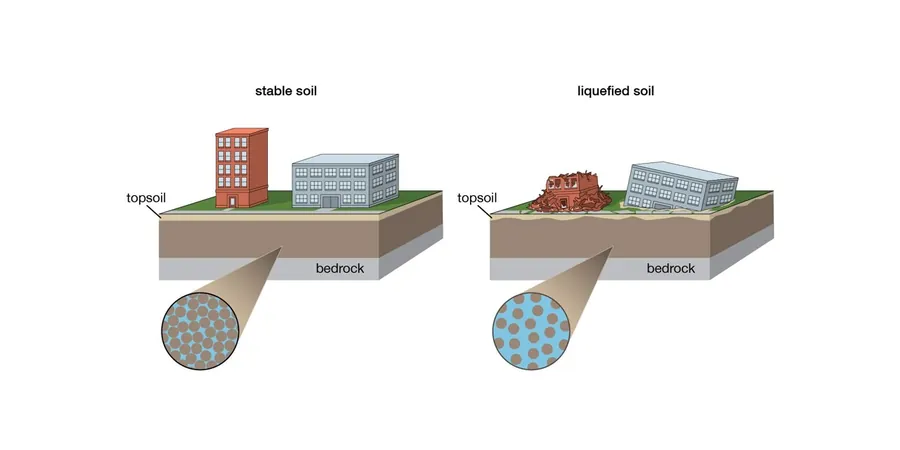
Longueuil sits on the south shore of the St. Lawrence River, just 16 meters above sea level, atop deep deposits of Champlain Sea clay and loose alluvial sands. The 1988 Saguenay earthquake, felt strongly here, reminded engineers that eastern Canada's intraplate seismicity can't be ignored. For any mid-rise or industrial project in this flat, river-adjacent terrain, a soil liquefaction analysis becomes the first line of defense against sudden ground failure. We run site-specific assessments using SPT-based triggering procedures, cross-checked with CPT testing where the sand layers are too thin for reliable blow counts. The goal is straightforward: determine if your saturated loose soils will lose strength during the design seismic event, and what that means for your foundations. In Longueuil's variable subsurface, skipping this step is a calculated risk most structural engineers won't accept.
Liquefaction doesn't just tilt buildings — it can sever buried utilities and float underground tanks. In Longueuil's soft soils, a site-specific analysis is the only way to quantify that risk.
Local considerations
Longueuil's urban grid expanded rapidly in the 1960s and 70s, filling low-lying areas near the river with hydraulic sand fill — material that is young, loose, and highly susceptible to liquefaction. When the 1732 Montreal earthquake struck, the region experienced severe ground failure; a repeat of that magnitude 5.8 event today would test every building not designed for lateral spreading. The soft Champlain clay underneath adds a compounding risk: cyclic softening and strength loss that can amplify ground motion. We see this in the eastern sectors of the city, where the clay is thicker and the sand lenses are discontinuous. A proper liquefaction analysis doesn't just flag hazard — it gives you the residual strength parameters needed to design deep foundations or ground improvement that actually work under seismic loading.
Applicable standards
NBCC 2020 (Division B, Part 4, Seismic Design), NCEER/Youd-Idriss (2001) — SPT-based liquefaction triggering, Boulanger & Idriss (2014) — CPT-based liquefaction triggering, ASTM D1586-18 — Standard Penetration Test, ASTM D7400-19 — Downhole Seismic Testing (for Vs)
Frequently asked questions
Is liquefaction analysis mandatory for small commercial buildings in Longueuil?
Under NBCC 2020, if your site is classified as Site Class D, E, or F and lies in a moderate-to-high seismic zone, the geotechnical investigation must address liquefaction potential. Even for a single-storey commercial building, if the subsurface contains saturated loose sand within the top 15 meters, the structural engineer will require a liquefaction assessment to justify the foundation type.
How much does a soil liquefaction analysis cost in Longueuil?
The typical range is CA$3,040 to CA$5,250, depending on the number of boreholes, the depth to competent ground, and whether CPT soundings or MASW surveys are added to refine the analysis. A single-family lot with one SPT borehole falls at the lower end; a multi-borehole commercial site with LPI mapping and settlement analysis runs higher.
What happens if my site fails the liquefaction analysis?
Failure means the factor of safety drops below 1.0 for one or more soil layers. That doesn't stop the project — it means the foundation design must account for it. Options include deepening to dense till, using piled foundations with down-drag considerations, or improving the ground with stone columns or compaction grouting. We provide the residual strength and settlement parameters for each scenario.
How long does the field and lab work take for a typical Longueuil site?
Mobilization, drilling, and SPT sampling for two boreholes typically takes two to three days on site. Laboratory grain-size and Atterberg tests add another seven to ten days. The engineering analysis and report are usually delivered within three weeks of completing fieldwork, assuming no winter drilling delays.