Longueuil sits on the south shore of the St. Lawrence River, where the subsurface is dominated by deep, compressible Champlain Sea clays deposited over 10,000 years ago. These sensitive silty clays can lose strength when disturbed, making conventional shallow foundations risky for anything beyond light residential structures. A stone column design bridges the gap between poor native soil and the structural loads of mid-rise buildings, tanks, and embankments. On sites between Vieux-Longueuil and Saint-Hubert, we often see 8 to 25 meters of soft clay before reaching competent till, and that demands a ground improvement strategy that controls both settlement and bearing capacity. The vibrocompaction process can densify granular fills, but where the fine-grained matrix dominates, stone columns installed by wet or dry bottom-feed methods become the reliable alternative.
A well-designed stone column grid in Champlain Sea clay can reduce post-construction settlement by over 70 percent compared to untreated ground, while providing a verified drainage path for seismic pore pressure relief.
Local considerations
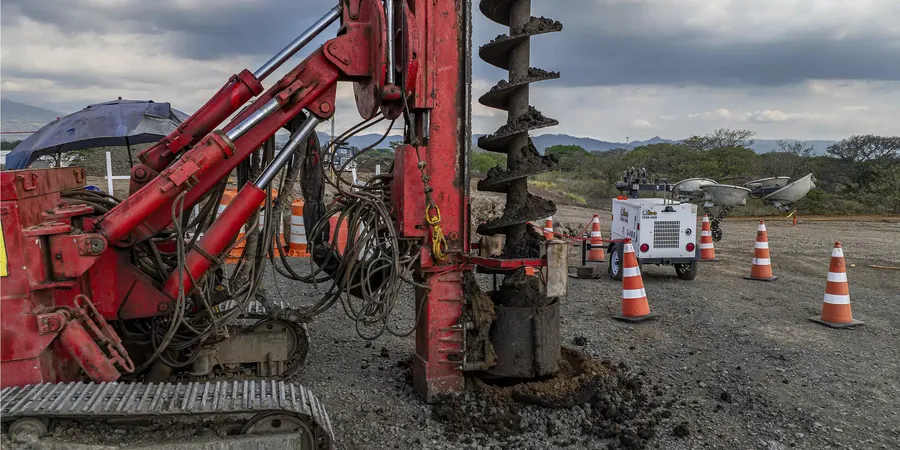
The bottom-feed vibroflot rig used for dry installation in Longueuil operates with a 130–180 kW vibrator mounted on a crawler crane, feeding stone through a hopper and down a central tube to the tip. In the sensitive clays found across the Montérégie region, the operator must control the withdrawal rate and amperage carefully: pulling the vibrator up too fast creates necking, while excessive dwell time can remold the surrounding clay and temporarily reduce its shear strength by 40 percent or more. We monitor column construction in real time, recording depth, amperage, and stone consumption per 0.5-meter lift. Post-installation, we verify column continuity with a full-depth probe or, on critical structures, a short CPT sounding through the column center. A missed neck at 4 meters depth in a Longueuil industrial slab can translate into a 50-millimeter differential settlement that cracks partition walls and binds overhead doors.
Applicable standards
NBCC 2020 – Seismic hazard for Longueuil (Sa 0.2 = 0.69, Site Class C reference), ASTM D5777 – Standard Guide for Seismic Refraction, referenced for depth-to-bedrock confirmation, CSA A23.3 – Design of concrete structures, for load transfer platform design over stone columns, NCEER 1997 (Youd & Idriss) – Liquefaction triggering for silty soils, EN 14731 (European reference) – Execution of special geotechnical work: ground treatment by deep vibration
Frequently asked questions
How much does a stone column design for a Longueuil project cost?
Professional fees for stone column design and field verification in Longueuil typically range from CA$2,030 to CA$8,070, depending on the treated area, number of columns, and required instrumentation. A small commercial pad under 500 m² sits at the lower end; a multi-building industrial complex with zone load tests and piezometer arrays moves toward the upper end.
Why use stone columns instead of rigid piles in Champlain Sea clay?
Stone columns improve the entire soil mass rather than bypassing it. In Longueuil clays, rigid piles transfer all load to deep till, which works but costs more and introduces structural connections. Stone columns reduce settlement directly, add drainage for seismic pore pressure, and allow lighter, less expensive ground-floor slabs.
How do you confirm the columns were installed correctly?
We verify each column during installation using real-time data acquisition: depth, vibrator amperage, and stone consumption per lift. After installation, we probe the full column depth on a sampling basis and may run a CPT through selected columns. For critical structures, a zone load test with settlement plates provides direct modulus and deformation data.
Can stone columns be installed year-round in Longueuil?
Yes, with planning. The dry bottom-feed method works in frozen conditions if the working platform is maintained. We typically place a 1.0–1.5 meter granular working mat before column installation, which isolates the rig from frost-susceptible surface soils and provides a stable platform for the crawler crane.