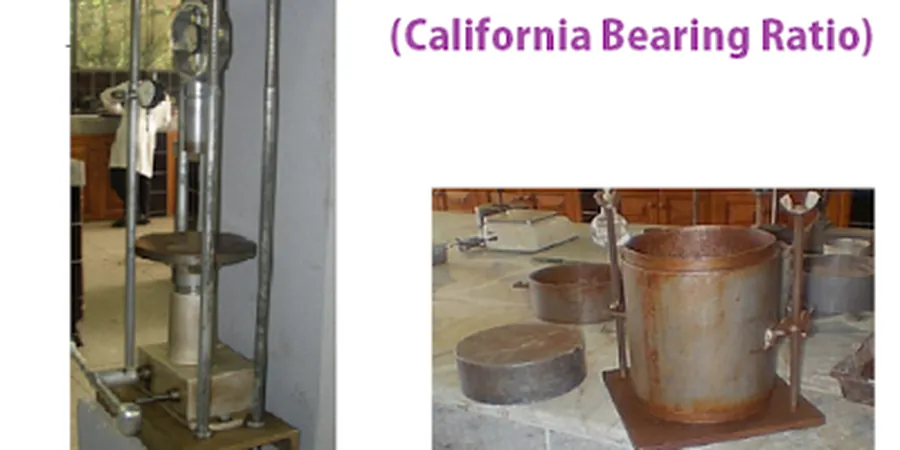
Beneath Longueuil’s surface, the Champlain Sea clay meets a dense glacial till layer that varies dramatically within just a few city blocks. From the redeveloped sectors near Place Charles-Le Moyne to the industrial corridors along Route 116, subgrade strength can shift from soft, sensitive marine silt to stiff, overconsolidated till. The laboratory CBR test provides a direct measurement of bearing capacity under controlled moisture and density conditions, an essential input when the difference between a durable pavement and premature rutting often comes down to how well the base course is characterized. Having processed hundreds of samples from Longueuil’s mixed geology, our team knows that remolding at field moisture content and running the penetration piston through a 4‑10” diameter specimen gives the most reliable design values. In projects near the Saint Lawrence River, where groundwater sits less than 2 m below grade, a conventional field test alone can miss the seasonal weakening that a soaked laboratory CBR test reveals. For deeper stratigraphic context, we often pair the CBR with SPT drilling to log refusal depths and identify where the till transitions into bedrock.
A soaked laboratory CBR test reveals the subgrade's weakest condition — the value you must design for, not the dry-season number.
Methodology and scope
Longueuil sits at roughly 15 m above sea level, but the soil profile beneath the city tells a story that goes much deeper — the Champlain Sea deposited up to 60 m of clay in some pockets, and the CBR values we measure in those fines can drop below 3% when saturated. The laboratory CBR test follows ASTM D1883 and AASHTO T-193, where a compacted specimen is soaked for 96 hours before a standard piston penetrates at 1.27 mm/min. In our experience across the South Shore, the soaked CBR is the make-or-break number: a subgrade that reads 12% at natural moisture can fall to 4% after four days of saturation, and that single shift changes the pavement structural number by a full tier. We measure both the 0.1-inch and 0.2-inch penetration values, reporting the higher of the two unless a correction is required, and we always run a companion moisture-density curve so engineers can see exactly where the soil lies relative to its optimum.
When the project involves granular base course specification, we complement the CBR with
grain size analysis to confirm the percent passing No. 200 sieve, which directly affects drainage and frost susceptibility — a non-trivial detail in a climate where the frost penetration depth exceeds 1.5 m. The lab’s mechanical compactor is calibrated monthly against AASHTO T-180 energy levels, and every CBR mold is weighed before and after soaking to document water absorption, a proxy for the soil’s sensitivity to moisture changes that we’ve seen correlate strongly with post-winter pothole formation in Longueuil’s residential streets.
Local considerations
The contrast between Vieux-Longueuil’s dense till subgrades and the marine clay basins near Parc Michel-Chartrand illustrates why a single assumed CBR value can be a costly gamble. In the older central neighborhoods, glacial till often yields CBR values above 20%, and pavement designs from the 1980s still perform well because the native material provides a stiff platform. Move two kilometers east toward the clay belt, and the same pavement section would fail within three freeze-thaw cycles. The laboratory CBR test exposes this vulnerability through the soaking phase: when a remolded clay specimen absorbs 8–12% water by volume during the 96-hour soak, the penetration resistance drops sharply, and the resulting CBR of 3–5% demands either a thicker granular base or chemical stabilization. During the 1998 ice storm, saturated subgrades in Longueuil’s low-lying sectors experienced bearing failures under emergency vehicle loads, a reminder that extreme weather events test the pavement system at its weakest link. Even in commercial developments where the structural section follows MTQ standard drawings, we recommend verifying the CBR at formation level because the transition zone between till and clay can be less than 50 cm thick — narrow enough for a grader operator to miss, but enough to concentrate differential settlement under repeated axle loads.
Frequently asked questions
How much does a laboratory CBR test cost in Longueuil?
A single-point soaked laboratory CBR test, including standard Proctor compaction and the 96-hour soaking period, typically runs between CA$170 and CA$290 per specimen. The exact cost depends on whether we need to run a companion moisture-density curve from scratch or if the optimum moisture is already known from previous testing on the same material. For projects requiring three or more points to establish a CBR-moisture relationship, we provide a reduced per-specimen rate.
What is the difference between a field CBR and a laboratory CBR test?
A field CBR test uses a falling weight or penetration jack directly on the subgrade surface and gives a quick in-situ reading, but it cannot control moisture content. The laboratory CBR test remolds the soil to a target density and soaks it for four days before penetrating, simulating the worst-case scenario after seasonal saturation. In Longueuil’s marine clays, the field CBR can be three times higher than the soaked lab value, which is why most municipal pavement designs require the laboratory number.
How long does it take to get CBR test results?
The standard turnaround is five to seven business days. The soaking period alone is 96 hours, and after penetration testing we need 24 hours for data reduction, curve correction if needed, and report preparation. If the project is on a tight schedule, we can run the moisture-density curve in parallel and have the preliminary CBR value ready within 24 hours after the soak ends.
Which CBR value should I use for pavement design — 0.1 inch or 0.2 inch?
Per AASHTO T-193, you use the higher of the two penetration values unless a correction is required for concave-upward curves. In Longueuil’s fine-grained soils, the 0.2-inch value is often higher because the piston has passed through the remolded surface crust by then. We report both numbers and note which one governs, along with the correction factor if applied.