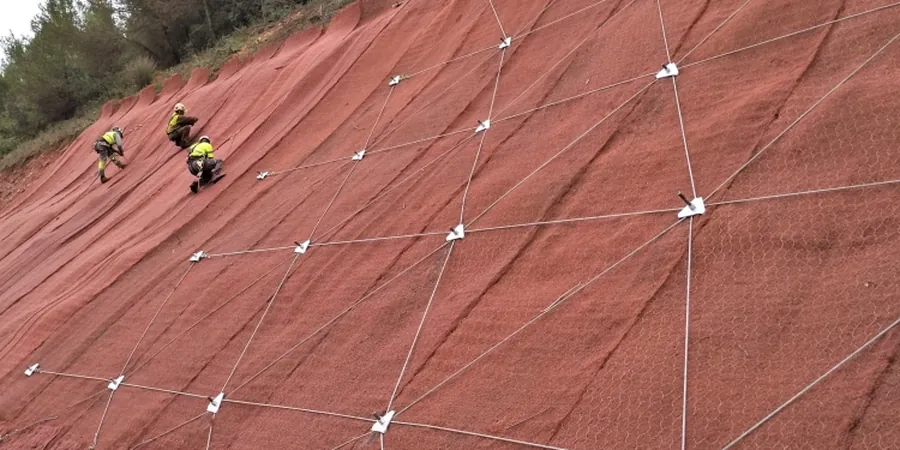
Longueuil’s expansion from a railway suburb into a major South Shore hub placed infrastructure directly atop the sensitive Champlain Sea clays. These post-glacial deposits, ranging from stiff crust near the surface to soft, high-plasticity silt and clay at depth, govern every cut and embankment. A standard safety factor of 1.5 against global failure is rarely adequate without a detailed slope stability analysis that accounts for strain-softening behavior. The 2019 landslides along the Richelieu River, though minor, reminded the engineering community that peak strengths measured in the lab often overstate the available field resistance. Our work across the boroughs of Vieux-Longueuil, Greenfield Park, and Saint-Hubert has demonstrated that effective stress parameters from consolidated-undrained triaxial testing, combined with pore pressure profiles from vibrating wire piezometers, produce the most reliable factor-of-safety calculations for long-term cuts. Because the city sits at an average elevation of only 15 m above sea level with a high water table in spring, drainage design becomes inseparable from the stability model itself. We often integrate deep excavation monitoring when slopes exceed 6 m in urban corridors, and we reference retaining wall alternatives where space constraints prevent a 2H:1V layback.
A 2-degree overestimation of the friction angle in Champlain Sea clay can reduce the calculated factor of safety by 15%, turning a stable design into a creeping failure.
Local considerations
A 7-story residential building on Chemin de Chambly encountered a 9-meter-deep excavation in 2018 where the original design assumed a uniform clay layer with a mean undrained shear strength of 50 kPa. Boreholes drilled at 30-meter intervals missed a 12-meter-wide lens of silty sand with artesian pressure 1.2 meters above the excavation base. The contractor began dewatering with deep wells, but the rapid drawdown triggered a retrogressive slide in the adjacent clay slope, moving the shoring wall 140 mm laterally in a single night. We were called in to install a real-time inclinometer array and to recalculate the stability using the Bishop simplified method with the actual pore pressure field. The revised design required a row of anchors at mid-height, tensioned to 80% of the lock-off load, and a toe berm compacted to 95% standard Proctor density. The lesson was clear: in Longueuil’s Champlain Sea deposits, a slope stability analysis must incorporate the three-dimensional variability of the soil and the transient seepage forces, not just the average undrained shear strength from a few Shelby tubes. Every project within the 45.52° N latitude band demands a site-specific model.
Applicable standards
NBCC 2015 – Part 4, Commentary L: Foundations and earth pressures, CSA A23.3-14 – Design of concrete structures (for reinforced soil nails and shotcrete facing), ASTM D1586-18 – Standard Test Method for Standard Penetration Test (SPT) and Split-Barrel Sampling of Soils, ASTM D422-63(2007) – Standard Test Method for Particle-Size Analysis of Soils, ASTM D4318-17e1 – Standard Test Methods for Liquid Limit, Plastic Limit, and Plasticity Index of Soils
Frequently asked questions
What is the typical cost range for a slope stability analysis in Longueuil?
For a single-family lot slope assessment, the cost ranges from CA$1,600 to CA$3,200. For a multi-story building or infrastructure project requiring CPTu, laboratory testing, and FEM modeling, the price typically falls between CA$3,800 and CA$5,870, depending on the number of cross-sections and the complexity of the groundwater regime.
Why are Champlain Sea clays in Longueuil considered a risk for slope stability?
These clays were deposited in a saline marine environment and later leached by freshwater infiltration, creating a metastable, flocculated structure. When disturbed, they can lose up to 90% of their original strength — a behavior called sensitivity. Even a small excavation can trigger a progressive failure if the strain exceeds the peak strength envelope.
What minimum factor of safety does the NBCC require for permanent slopes?
The National Building Code of Canada (NBCC 2015, Commentary L) requires a minimum static factor of safety of 1.5 for permanent slopes under long-term drained conditions. For pseudo-static seismic loading using the Longueuil spectral acceleration, the code allows a reduced factor of 1.1, provided the deformation analysis confirms acceptable lateral displacement.
How do you verify the slope stability analysis results before construction?
We install inclinometer casings and vibrating wire piezometers at multiple depths to cross-check the actual pore pressure and displacement against the model predictions. The data are collected every 4 hours during excavation and compared with the predicted deformation profiles. If the rate of movement exceeds 0.5 mm/day, we implement contingency measures such as toe berms or relief drains.