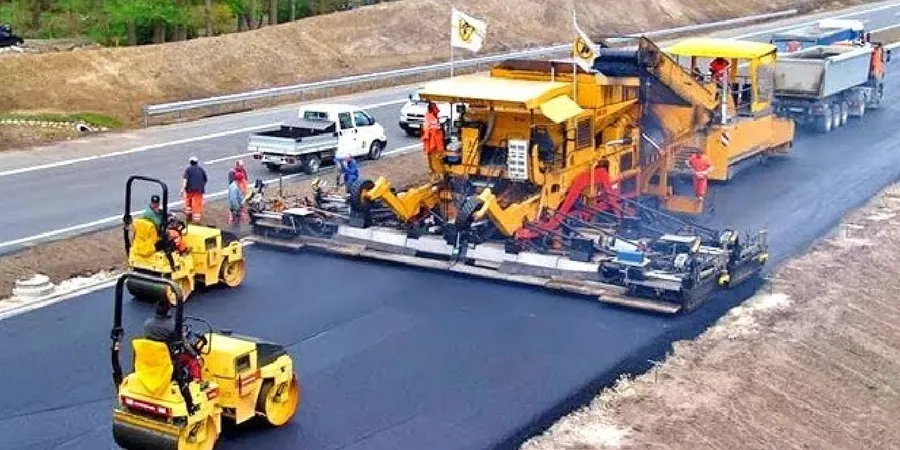
Most Longueuil parking lots we inspect fail first at the curb line, not the wheelpath. The reason is almost always the same: subgrade moisture trapped in Champlain Sea clay. A flexible pavement section works because it distributes wheel loads layer by layer, but only if the subgrade modulus is real — not assumed. We pull Shelby tubes from the exact depth of influence, run Proctor tests to lock in optimum moisture and maximum dry density, then feed that into AASHTO 93 structural design. For projects near the Saint Lawrence escarpment, we also specify a separation geotextile between the granular base and the native silt to stop fines migration. The city’s average frost penetration of 1.4 m means any asphalt thickness below 100 mm simply won’t survive two winters. We design from the subgrade up, not the wearing course down.
We treat Longueuil’s Champlain clay as a structural layer, not just ‘bad ground’ — and we prove its modulus before a single tonne of asphalt leaves the plant.
Frequently asked questions
How much does a flexible pavement design cost for a typical Longueuil commercial lot?
For a standard commercial parking lot or access road in Longueuil, the design package — including subgrade investigation, lab CBR, and AASHTO 93 structural calculation — runs between CA$2,230 and CA$6,160 depending on the number of boreholes and traffic data complexity.
What is the minimum asphalt thickness you recommend for Longueuil’s frost conditions?
We never specify less than 100 mm of hot-mix asphalt in two lifts for any vehicular pavement in Longueuil. The 1.4 m frost penetration depth combined with saturated Champlain clay demands enough structural mass to bridge soft spots during spring thaw, and a thinner section will crack within two freeze-thaw cycles.
Do you always use a geotextile separator under the granular base?
We specify a nonwoven geotextile meeting AASHTO M288 separation class whenever the subgrade CBR is below 4% soaked. In Longueuil, that covers most sites on the central marine plain. The geotextile stops fines migration into the stone base and pays for itself by eliminating the 50–75 mm of additional base aggregate that would otherwise be needed to compensate for contamination over time.