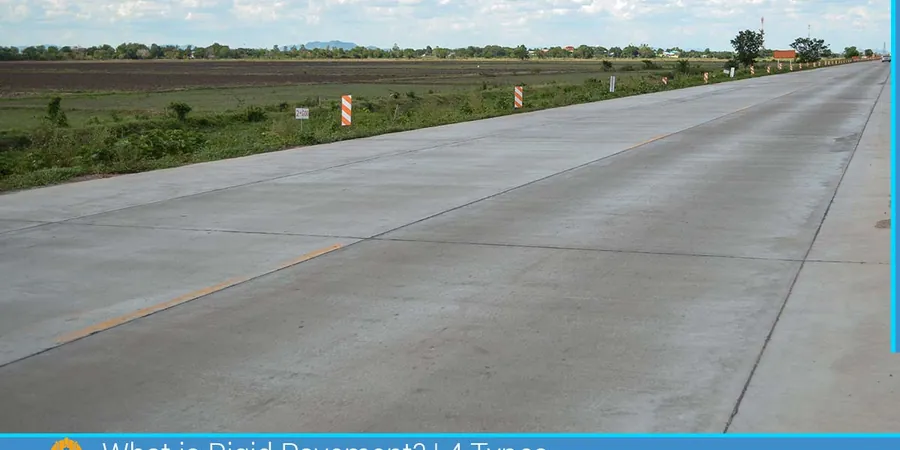
With over 250,000 residents spread across a territory that sits barely 20 meters above the St. Lawrence River, Longueuil deals with a water table that rises and falls dramatically with the seasons. That fluctuation, combined with the sensitive Champlain Sea clay underlying much of the South Shore, makes rigid pavement design a structural problem, not just a civil one. Concrete slabs here work in a moisture regime that would destroy a poorly designed pavement within two freeze-thaw cycles. Our team approaches every Longueuil project with a drainage-first mindset: if the subgrade stays saturated, even a 300 mm slab on granular base will pump fines and lose support. We apply the AASHTO 93 rigid pavement method, cross-checking fatigue consumption and erosion damage against the actual traffic mix supplied by the design engineer, and we never skip the frost-depth verification required by the Quebec provincial supplement to the TAC pavement guide.
A rigid pavement in Longueuil fails first at the joints, not in the slab center: water, frost, and loss of base support drive 90 percent of the distress we see.
Frequently asked questions
What thickness of rigid pavement is needed for a Longueuil municipal road?
For a typical two-lane municipal road with bus traffic and occasional heavy trucks, the AASHTO 93 rigid pavement design usually yields a plain jointed concrete slab between 200 mm and 230 mm, assuming a 150 mm granular subbase over a properly compacted clay subgrade. The final thickness depends on the 20-year ESAL projection: a road carrying 1 million equivalent single axle loads over its design life may require 200 mm, while 5 million ESALs can push the section to 230 mm or more. All concrete must be air-entrained at 5 to 7 percent with a minimum 28-day compressive strength of 32 MPa per CSA A23.1.
How much does a rigid pavement design cost in Longueuil?
A complete rigid pavement design package, including subgrade investigation, plate load testing, AASHTO 93 thickness analysis, joint detailing, and a stamped engineering report, ranges from CA$2,240 to CA$8,690. The price depends on the pavement area, the number of soil investigation points required, and the complexity of the traffic data analysis. A small commercial parking lot with one borehole and standard traffic assumptions sits at the lower end, while a multi-street industrial subdivision with full geotechnical profiling and ESAL modeling reaches the upper range.
How do Longueuil's clay soils affect rigid pavement performance?
The Champlain Sea clay that underlies much of Longueuil is highly frost-susceptible and loses bearing capacity when saturated. If the pavement section does not include a drainage layer and adequate frost protection, the clay will heave unevenly during the winter, lifting slab corners and breaking the load transfer at the joints. We address this by specifying a minimum granular replacement depth that reaches the frost penetration level, installing edge drains to keep the water table below the subbase, and verifying the subgrade reaction modulus with field plate load tests rather than relying on empirical correlations that underestimate clay sensitivity.