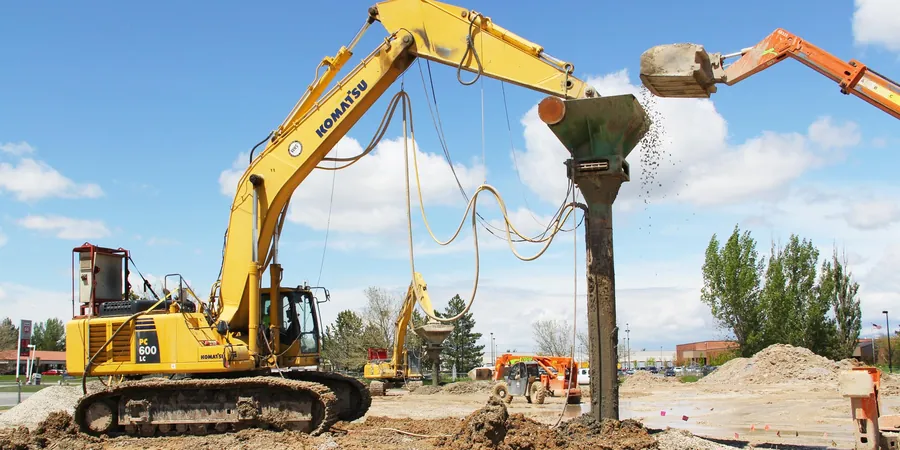
Contrasting soil profiles between Old Longueuil and the newer Greenfield Park sector highlight why a standard approach to ground improvement fails here. The older core sits on compact glacial till, but moving south toward the former agricultural plains, you hit loose alluvial sands extending 6 to 12 meters deep. These recent deposits, typical of the St. Lawrence Lowlands, need more than surface compaction — they require an engineered densification strategy. We design vibrocompaction programs that target density increases to 70-85% relative density (Dr) using depth-specific grid patterns. For sites near the river where clean sands dominate, the method proves particularly effective, though we often pair it with a CPT testing campaign before and after to quantify improvement ratios.
Amperage draw during probe extraction tells us more about achieved density than any post-treatment SPT value alone.
Local considerations
The Champlain Sea clays underlying much of Longueuil create a specific risk when vibrocompaction is applied above them. While the method densifies the overlying sand layer, it does nothing to consolidate the sensitive clay below — and the added vibration can, in rare cases, trigger localized remolding if the clay is close to its sensitivity threshold. The South Shore's water table sits high, typically 1.5 to 3 meters below grade, so pore pressure buildup during compaction must be monitored with piezometers. Neglecting this step can lead to a temporary loss of effective stress, delaying the project and requiring liquefaction assessment to confirm the treatment hasn't been compromised. Another consideration is proximity to existing infrastructure: the Longueuil metro tunnel and older masonry buildings in Vieux-Longueuil require vibration monitoring with triaxial geophones to stay within PPV limits defined by the CNESST.
Frequently asked questions
What soil types in Longueuil respond best to vibrocompaction?
The clean to slightly silty alluvial sands found across much of Longueuil's South Shore are ideal for vibrocompaction. The method works effectively when fines content stays below 15 percent and the sand is fully saturated below the water table, which sits at about 1.5 to 3 meters depth here. Sites with significant clay lenses or organic layers need a different approach, which is why we always run a grain-size analysis and CPT first.
How long does a vibrocompaction treatment take for a typical residential lot?
For a standard single-family residential lot of roughly 600 square meters in Longueuil, the probe work itself is usually completed in one to two days. The full cycle — including mobilization, treatment, pore pressure dissipation waiting period, and post-treatment CPT verification — spans about seven to ten calendar days, weather permitting.
What verification method confirms the ground improvement worked?
We rely on pre- and post-treatment cone penetration testing at the centroid of the compaction grid. The ratio of post-treatment tip resistance to pre-treatment values gives a direct measure of density increase. We also run occasional SPTs and, on larger projects, pressuremeter tests to validate the stiffness gain for foundation design purposes.
Does vibrocompaction reduce the seismic site class for my Longueuil project?
Yes, in many cases. Loose sands in Longueuil typically fall under NBCC Site Class D or E. Effective vibrocompaction can raise the relative density enough to reclassify the site as Class C, which reduces the design spectral acceleration values and can lead to more economical foundation and structural designs.
What is the typical cost range for a vibrocompaction design in Longueuil?
Design fees for a vibrocompaction program in Longueuil generally range from CA$1,900 to CA$8,020, depending on the treated area, depth of loose sand, and the number of verification soundings required. A small residential job with straightforward access falls at the lower end, while a larger commercial site requiring vibration monitoring near existing structures and multiple CPT verification rounds moves toward the upper end.