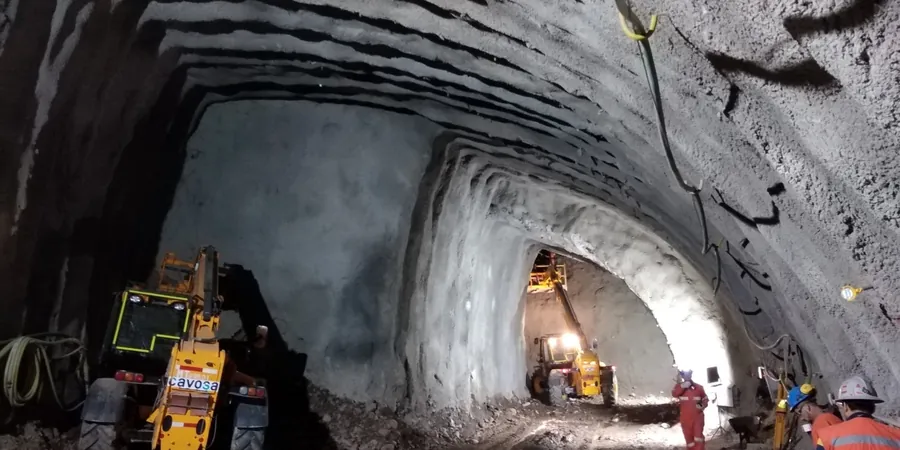
In Longueuil, anyone who has excavated below five meters along the Route 132 corridor knows the problem: the gray, sensitive clay doesn't give warning signs before moving. The Champlain Sea deposits that underlie most of the city present a serious challenge for tunnel engineers. These post-glacial clays can lose up to 90% of their undisturbed strength when remolded, which means that a small construction error can trigger large deformations. A proper geotechnical analysis for soft soil tunnels must integrate field data from cone penetration tests, vane shear readings, and high-quality Shelby tube sampling to define the undrained shear strength profile before any TBM or sequential excavation method is selected. The risk of face instability or excessive surface settlement is real, and it demands a level of investigation that goes far beyond a standard borehole log.
In Longueuil's Champlain clays, a 1% change in moisture content can reduce undrained shear strength by more than 15%, making precise laboratory conditioning non-negotiable.
Methodology and scope
With a population of over 250,000 and growing pressure on the Longueuil–Université-de-Sherbrooke metro extension, the city faces a unique geotechnical reality. Much of the urban core sits on 20 to 60 meters of soft, compressible marine clay overlying glacial till and shale bedrock. The laboratory program for soft ground tunnel design must comply with ASTM D4767 for consolidated-undrained triaxial testing and ASTM D2435 for one-dimensional consolidation, establishing the stress history and OCR profile. The analysis quantifies long-term consolidation settlements under drained conditions and short-term stability during excavation under undrained conditions. A critical output is the face support pressure envelope for closed-face TBMs, derived from the undrained shear strength and the overburden stress. The team also evaluates the influence of nearby foundations on the tunnel alignment, modeling soil-structure interaction with finite element codes such as PLAXIS 2D and 3D to predict the settlement trough width and depth.
Local considerations
The contrast between the Vieux-Longueuil borough and the newer developments in Saint-Hubert illustrates the variability. Near the river, the clay is thicker and more sensitive, with documented landslides dating back to the 19th century. In Saint-Hubert, the clay thins and the till is shallower, reducing the risk of large-scale instability but introducing the challenge of mixed-face conditions at the tunnel crown. The biggest threat is face collapse during open-face excavation, driven by negative pore pressures that fail to develop in the short construction window. To mitigate this, our analysis specifies real-time monitoring of pore pressure dissipation and recommends contingency plans for compressed air intervention or ground freezing if the face stability number exceeds critical thresholds.
Frequently asked questions
What is the typical cost range for a soft ground tunnel geotechnical investigation in Longueuil?
For a tunnel alignment of typical urban length, the investigation program ranges from CA$6.070 to CA$26.140, depending on the number of boreholes, the depth of the alignment, and the extent of laboratory testing required. A site-specific proposal is always provided after reviewing the preliminary tunnel geometry.
How are the design parameters for an EPB tunnel face support derived from the test results?
The face support pressure is calculated using the undrained shear strength profile from CPTu and triaxial tests, combined with the overburden stress at the tunnel axis. The analysis applies limit equilibrium methods, such as the wedge stability model, and is verified with finite element simulations to account for the non-linear stiffness of the Champlain clay.
What distinguishes the Champlain Sea clay from other soft soils in tunnel design?
The high sensitivity, strong anisotropy, and significant creep potential set it apart. These clays exhibit a pronounced strain-softening behavior and a low horizontal-to-vertical effective stress ratio, which affects the shape of the settlement trough and the long-term lining loads.