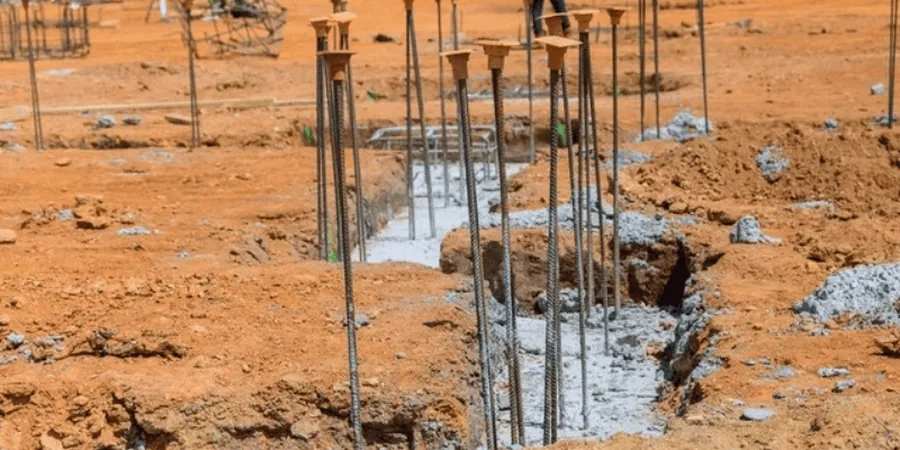
Longueuil sits on a complex glacial and marine deposit sequence, with the Champlain Sea clay extending up to 30 meters deep across much of the South Shore before hitting competent till or bedrock. Any mid-rise or heavy structure in this municipality must transfer loads below the sensitive crust layer—this is where pile foundation design becomes non-negotiable. Our team has worked extensively with driven H-piles and drilled cast-in-place shafts across Longueuil, dealing with negative skin friction in the organic silt pockets near the St. Lawrence River. A proper site investigation, often starting with an SPT drilling program, defines the depth to refusal and the lateral variability of the clay, which is essential input for our axial capacity models. We don't guess at bearing strata; we correlate in-situ tests with lab-derived undrained shear strength to size the pile group precisely.
In Champlain Sea clay, shaft resistance often governs capacity long before end-bearing becomes relevant—ignoring setup effects leaves significant performance on the table.
Methodology and scope
A mistake we see contractors make in Longueuil is assuming that end-bearing on the glacial till is a guaranteed solution without checking for boulders or erratic bedrock depth. You can end up with pile refusal at 12 meters on one side of the site and 25 meters on the other, wrecking the schedule and budget. Our pile foundation design process sequences through a detailed stratigraphic model, beta-method shaft resistance calculations for the clay, and wave equation analysis for driveability. We specify pile load tests—both static and high-strain dynamic—to validate the design assumptions before production driving begins. The service covers: axial capacity for compression and tension, lateral load response under seismic demand per NBCC 2020, group efficiency factors, and settlement estimates that account for consolidation in the surrounding clay matrix.
We also evaluate downdrag forces in areas where fill placement or groundwater lowering is planned post-construction, a common scenario in the Vieux-Longueuil industrial expansion zones.
Local considerations
Across Longueuil, we regularly encounter a lens of loose silty sand trapped between the upper clay crust and the deeper competent till, particularly in sectors near the former shorelines. This layer can trigger premature plugging in open-ended pipe piles or lead to unexpected lateral squeeze during driving. A design that ignores this intermediate unit risks pile damage, inaccurate capacity estimates, and long-term differential settlement. We mitigate this by running signal-matching analysis on initial test piles and adjusting the driving criteria or pile shoe details accordingly. For sites with high groundwater and artesian conditions near the river, we also assess the need for temporary casing to maintain hole stability in drilled shafts, preventing necking and soil inclusion in the concrete.
Applicable standards
NBCC 2020 (National Building Code of Canada, seismic provisions for Site Class), CSA A23.3:19 (Design of Concrete Structures, deep foundation provisions), ASTM D1143 / D1143M-20 (Standard Test Methods for Deep Foundation Elements Under Static Axial Compressive Load), ASTM D4945-17 (Standard Test Method for High-Strain Dynamic Testing of Deep Foundations), CFEM (Canadian Foundation Engineering Manual, 4th Edition)
Frequently asked questions
What is the typical cost range for pile foundation design on a commercial project in Longueuil?
Professional engineering fees for pile foundation design generally range between CA$2,350 and CA$7,360, depending on the number of piles, the complexity of the soil profile, and the required load testing program. A straightforward single-structure design with standard soil conditions falls at the lower end, while multi-building sites with variable Champlain Sea clay thickness and dynamic testing requirements move toward the upper range.
How deep do piles typically need to go in Longueuil to reach competent bearing?
In most parts of Longueuil, the glacial till surface lies between 15 and 30 meters below grade, though isolated bedrock highs can appear shallower. Driven H-piles often achieve refusal at the till interface, while drilled shafts may socket 2 to 4 meters into sound till. A site-specific SPT or CPT investigation is the only way to map this depth accurately across a given parcel.
Do you account for soil setup and relaxation in Longueuil clay?
Yes. Champlain Sea clay exhibits significant thixotropic strength gain after pile driving. We incorporate setup factors based on published regional data and verify them with restrike PDA tests 7 to 14 days after initial driving. This often allows us to reduce pile lengths compared to end-of-driving criteria alone, generating cost savings.