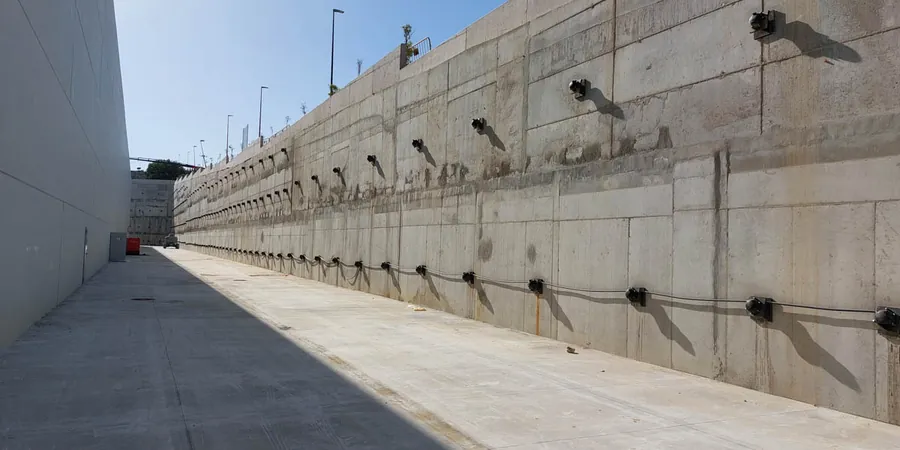
Anchor design in Longueuil must account for the sensitive Champlain Sea clays that underlie much of the city’s 170,000-resident territory. These post-glacial deposits, particularly east of the Saint-Lambert boundary, exhibit thixotropic behavior that can complicate load transfer in both active and passive systems. The National Building Code of Canada (NBCC 2020) classifies portions of the South Shore as Site Class D or E, requiring rigorous verification of bond lengths in the marine silt. Our approach integrates site-specific triaxial testing to define effective stress parameters for the grout-soil interface, ensuring the tieback capacity calculations match the actual stratigraphy encountered in Longueuil’s variable overburden.
Anchor capacity in Champlain Sea clay depends more on grout injection control than on steel tendon grade—hydrofracture prevention is the real design limit.
Applicable standards
NBCC 2020 (National Building Code of Canada), CSA A23.3:2019 (Design of Concrete Structures, Annex D), PTI DC-35 (Post-Tensioning Institute, Recommendations for Prestressed Rock and Soil Anchors), ASTM A416 / A416M (Steel Strand for Prestressed Concrete), CAN/CSA-A3000 (Cementitious Materials Compendium)
Frequently asked questions
What distinguishes active from passive anchors in Longueuil clay?
Active anchors are prestressed to a lock-off load—typically 70% of the design load for temporary works—which immediately engages the bonded length and limits wall deflection. Passive anchors develop resistance only as the structure moves, making them less suitable for sensitive Champlain Sea clay where even 25 mm of displacement can trigger progressive failure. In Longueuil, we specify active systems for most urban excavations adjacent to existing infrastructure, while passive anchors may be adequate for rock socket applications in the underlying shale of the Nicolet Formation.
Which standard governs anchor testing in Quebec?
CSA A23.3:2019 Annex D provides the mandatory testing protocol for soil and rock anchors in Canada. This includes proof testing at 133% of the design load, creep testing with incremental loading and a 60-minute hold period, and performance testing on sacrificial anchors. For permanent anchors in Longueuil, the PTI DC-35 recommendations add requirements for encapsulated tendon corrosion protection and lift-off testing at regular intervals after lock-off.
How is anchor bond length calculated in Champlain Sea deposits?
Bond length in Longueuil clay is determined using the effective stress method, where the ultimate bond stress is a function of the average effective overburden pressure, the grout-to-ground friction angle, and a soil adhesion factor calibrated to local CPT and vane shear data. A typical design bond stress in stiff Champlain clay ranges from 40 to 70 kPa. The calculation also applies a factor of safety of 2.0 to 2.5 on the grout-ground interface, as required by CSA A23.3.
What does anchor design and testing cost in Longueuil?
Anchor design and proof testing services in Longueuil typically range from CA$1.260 to CA$4.690 depending on anchor type, tendon capacity, and whether the project requires sacrificial performance testing. Temporary tieback design with standard proof testing falls at the lower end, while permanent double-encapsulated anchors with extended creep monitoring and lift-off verification represent the upper range.