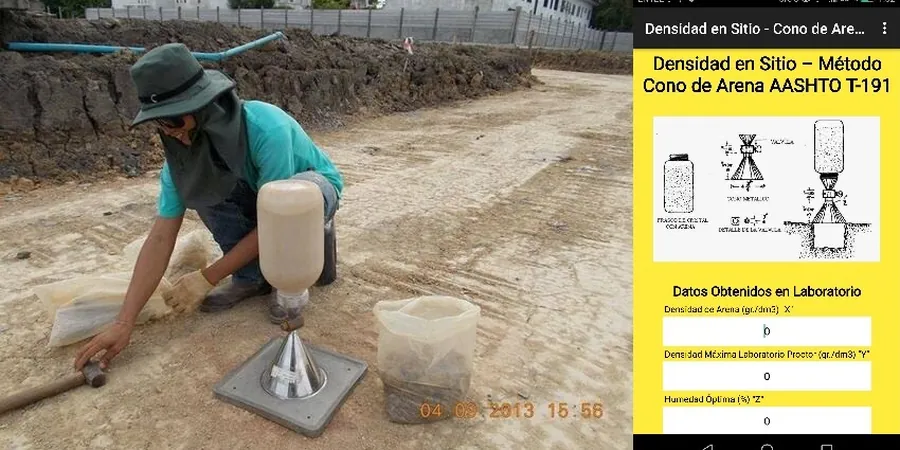
Between the dense clay deposits near Parc Michel-Chartrand and the looser granular fills along the Route 132 corridor, subgrade performance in Longueuil varies more than most engineers expect. On a recent warehouse pad in Saint-Hubert, the contractor achieved 95 percent Proctor in the upper 200 mm but dropped to 88 percent just 400 mm deeper — a difference that standard proof rolling would never catch. That is where the sand cone test becomes essential. The method gives us a direct, physical measurement of in-place density at the exact depth where compaction matters most, unaffected by the near-surface crust that can mask deeper problems. For Longueuil projects sitting on the Champlain Sea clays, we often pair the sand cone with in-situ permeability testing to check whether a compacted clay liner will actually function under saturated conditions.
Compaction quality is not about the top 100 millimetres — it is about what happens at the bottom of the lift, where the paver never reaches.
Local considerations
A six-storey residential project on Chemin de Chambly taught us a hard lesson about fill variability. The geotechnical report called for 95 percent Modified Proctor across the building footprint. Surface tests passed easily, but when we cut a trench through the centre of the pad to investigate differential settlement, we found a lens of uncompacted silty sand at 1.2 metres depth — right where the footing stress bulb peaks. The contractor had placed fill in 600 mm lifts instead of the specified 250 mm, and the sand cone caught it only after we insisted on testing at intermediate depths. In Longueuil, where the natural clay can consolidate under fill loads for years, a soft spot under a footing leads to long-term differential movement that cracks partition walls and binds doors. The sand cone test costs a fraction of a footing repair, and when combined with Atterberg limits to classify the fill material, it provides a defensible record that the compaction specification was met — or not met — before the concrete is poured.
Frequently asked questions
How much does a sand cone density test cost in Longueuil?
For projects on the South Shore, field density testing by the sand cone method typically ranges from CA$140 to CA$190 per test point, depending on the number of points per visit and travel distance within Longueuil. A full-day programme with 10 to 15 points brings the per-point cost toward the lower end of that range. The quote includes daily Ottawa sand calibration, moisture content determination by oven drying, and a signed PDF report.
How does the sand cone method compare to a nuclear density gauge?
The sand cone gives a direct volume measurement — you physically excavate the soil and fill the hole with calibrated sand, so there is no reliance on indirect radiation backscatter. In Longueuil's silty and micaceous fills, nuclear gauges can read 2 to 4 percent higher than the true density because the hydrogen content of bound water in the clay minerals affects the neutron moderation. The sand cone is slower but more defensible when compaction disputes arise.
How many test points do I need for my project?
For structural fill under buildings, the NBCC and typical specifications call for at least one test per 300 square metres per compacted lift. Road subgrades under MTQ jurisdiction require one test per 150 square metres. Utility trench backfill usually demands one test every 15 to 25 linear metres per lift. We can advise on the exact frequency during the pre-construction meeting based on your project's geotechnical report and the fill material classification.
Can you test in wet or saturated soils with the sand cone?
The reference range for this service in Longueuil is CA$140 - CA$190. The final price depends on the project scope and volume.