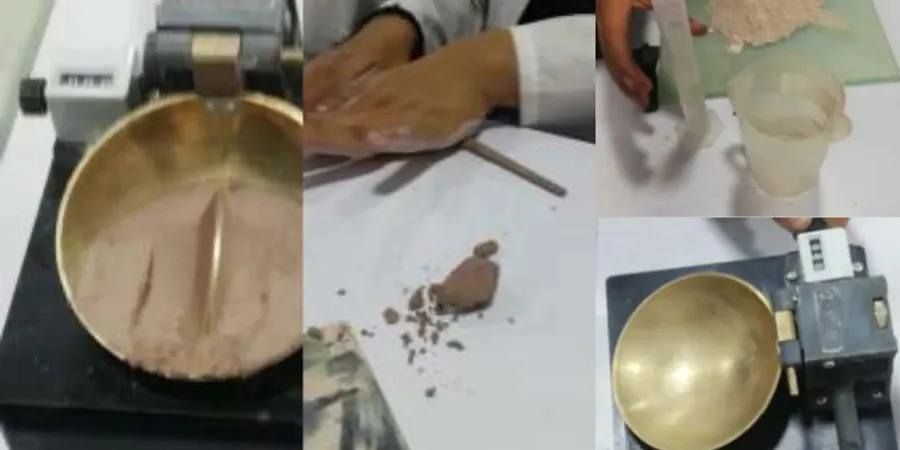
A recent excavation for a mid-rise residential complex near the Chemin de Chambly corridor exposed what Longueuil geotechnical engineers know intimately: homogeneous grey silty clay extending well beyond six meters depth, visibly saturated and sensitive to remolding. The contractor's immediate concern was bearing capacity, but the more fundamental question was how the soil's consistency would evolve through wet and dry construction cycles. This is where Atterberg limits testing becomes indispensable. By quantifying the liquid limit, plastic limit, and plasticity index according to ASTM D4318-17e1, we establish the moisture boundaries that govern soil behavior under load. In Longueuil's post-glacial Champlain Sea deposits, plasticity indices exceeding 25% are not uncommon, and ignoring these values can lead to misclassification of excavation difficulty, shrink-swell potential, and even erroneous undrained shear strength correlations. Our laboratory processes samples typically within 48 hours of extraction, ensuring that the water contents measured reflect in-situ conditions rather than drying-induced shifts that would skew the entire geotechnical model.
Plasticity index is not just a classification number — it governs the undrained shear strength ratio and the soil's sensitivity to disturbance in Longueuil's marine clays.
Local considerations
Longueuil sits within a region where the 1988 Saguenay earthquake (M5.9) and the broader Charlevoix seismic zone have shaped the engineering approach to soft soils. The city's population of approximately 250,000 occupies terrain underlain by Champlain Sea clays that can reach 60 meters in thickness along the river corridor. During cyclic loading, high-plasticity clays with PI exceeding 30% exhibit a different degradation pattern than low-plasticity silts, and the NBCC 2020 site classification — which feeds directly into the seismic design spectrum — relies in part on undrained shear strength parameters that are routinely correlated from Atterberg limits via relationships developed by Leroueil and others for eastern Canadian clays. A mischaracterized plasticity index leads to an incorrect site class, which cascades into either an overconservative or unconservative seismic design. Liquefaction assessment for silty zones near the Saint-Lawrence shoreline also depends on fines content and plasticity, since clays with PI > 15% are generally considered non-liquefiable under the Boulanger-Idriss (2014) framework, a distinction that directly impacts foundation type and cost.
Applicable standards
ASTM D4318-17e1 — Standard Test Methods for Liquid Limit, Plastic Limit, and Plasticity Index of Soils, ASTM D2487-17e1 — Standard Practice for Classification of Soils for Engineering Purposes (Unified Soil Classification System), CSA A23.3-19 — Design of Concrete Structures (references soil classification for foundation design provisions under NBCC), NBCC 2020 — National Building Code of Canada, Part 4 Structural Design (soil parameter requirements for seismic site classification)
Frequently asked questions
What is the typical cost for Atterberg limits testing in Longueuil?
For a standard set of Atterberg limits (liquid limit, plastic limit, and plasticity index) on one sample, the fee ranges from CA$100 to CA$130, depending on whether the sample requires wet preparation due to organic content or high sensitivity. Multi-sample projects or combined classification packages benefit from reduced per-sample rates. The price includes the certified laboratory report with the flow curve and USCS classification.
How do Atterberg limits relate to the sensitivity of Longueuil's marine clays?
The liquidity index, calculated from the natural water content relative to the liquid and plastic limits, provides a direct indication of sensitivity. When LI approaches or exceeds 1.0, the in-situ water content is at or above the liquid limit, meaning the clay can transition to a fluid-like state upon remolding. This is characteristic of the Champlain Sea 'quick clays' found in pockets across the Montérégie region and is critical for assessing excavation stability and retrogression potential.
What sample quantity is required for Atterberg limits testing?
We require approximately 300 grams of material passing the No. 40 (425 µm) sieve for the complete Atterberg suite. This is typically obtained from a 75 mm diameter Shelby tube sample or from a representative bulk sample of about 2 kg taken from a test pit. For highly sensitive clays, we recommend undisturbed tube samples to preserve the in-situ water content, as drying during transport can alter the measured limits and produce a misleadingly low plasticity index.