← Home · Foundations

Raft/Mat Foundation Design in Longueuil: Load Distribution on Sensitive Clay

Together, we solve the challenges of tomorrow.

LEARN MORE →

Longueuil’s expansion from a quiet riverside settlement into a dense South Shore hub has placed immense pressure on its underlying geology. The city sits squarely on the Champlain Sea clay plain, a post-glacial deposit that reaches depths of over 30 metres in some sectors. This marine clay is notoriously sensitive and prone to large consolidation settlements. Simple footings often cannot handle the resulting differential movement. A raft or mat foundation becomes the logical solution. It bridges soft zones and reduces contact pressure by spreading structural loads across the entire footprint. The team has tackled this on multiple mid-rise projects near the Longueuil Metro corridor, where the stratigraphy shifts from stiff crust to soft silty clay within just a few metres. Complementing the raft design with in-situ permeability testing helps quantify the consolidation rate under sustained building loads.

A well-designed raft on Longueuil clay can limit total settlement to 25 mm while eliminating the need for deep piling, provided the crust is preserved intact during excavation.

Methodology and scope

The National Building Code of Canada (NBCC 2020) and CSA A23.3 govern structural design, but the geotechnical backbone for raft foundations in Longueuil relies on site-specific parameters derived from ASTM D2488 logging and consolidation testing. The Saint-Lambert clay, for instance, typically shows an overconsolidation ratio (OCR) of 1.2 to 1.8 in the upper 5 metres, dropping to normally consolidated values below that depth. A raft must be thick enough to provide rigidity—often 600 mm to 1,200 mm for residential towers—while remaining economical. We model soil-structure interaction using modulus of subgrade reaction values that account for the crust's stiffness degradation. Key characteristics include: For projects near the Saint Lawrence River, where alluvial sands interfinger with the clay, a preceding CPT test provides the continuous stratigraphic profile needed to position the raft at the correct bearing elevation.
Raft/Mat Foundation Design in Longueuil: Load Distribution on Sensitive Clay
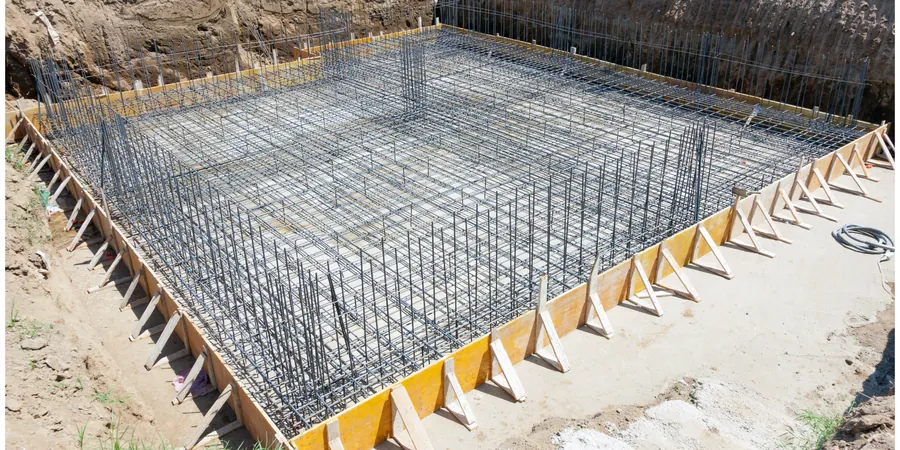
Technical reference image — Longueuil

Local considerations

The contrast between the Vieux-Longueuil plateau and the low-lying LeMoyne sector illustrates the risk spectrum. Vieux-Longueuil often retains a stiff, desiccated clay crust up to 4 metres thick. LeMoyne, closer to the river, shows a thinner crust and softer underlying clay with water contents exceeding 60%. A raft designed for the plateau's firm crust would undergo excessive differential settlement if applied blindly in LeMoyne. The biggest risk is underestimating the sensitivity of the Champlain clay: remoulding during excavation can destroy the crust's structure, reducing the bearing capacity by half. We mitigate this through strict excavation protocols that require a final 300 mm to be removed only after placing a mud slab. Seasonal water table fluctuations in Longueuil also demand solid drainage provisions beneath the mat to prevent buoyancy and softening of the subgrade over time.

Need a geotechnical assessment?

Reply within 24h.

Email: contact@geotechnical-engineering.org

Technical parameters

ParameterTypical value
Typical slab thickness (residential)600 – 900 mm
Typical slab thickness (commercial/industrial)800 – 1,200 mm
Target total settlement≤ 25 mm
Target differential settlement≤ L/500 (CSA A23.3)
Subgrade modulus (kv) range5 – 20 MN/m³ (crust)
Frost protection depth (NBCC)≥ 1.4 m below underside
Concrete class minimumC-2 (CSA A23.1, 35 MPa)
Reinforcement yield strength400W or 500W (CSA G30.18)

Associated technical services

01

Raft/MAT foundation analysis and detailing

Finite element modelling of the soil-raft system using subgrade reaction and continuum approaches. We deliver thickness optimization, reinforcement layout per CSA A23.3, and punching shear verification at column-raft interfaces for buildings up to 12 storeys on Longueuil's sensitive clay.

02

Construction-phase monitoring and QA/QC

On-site verification of excavation base integrity, mud slab placement, reinforcement positioning, and concrete placement under cold-weather conditions. Includes installation of settlement monitoring points and initial benchmark readings before structural framing begins.

Applicable standards

NBCC 2020 (Division B, Part 4), CSA A23.3:19 – Design of Concrete Structures, ASTM D2488 – Description and Identification of Soils (Visual-Manual Procedure), ASTM D2435 – One-Dimensional Consolidation Properties of Soils, CSA A23.1:19 – Concrete Materials and Methods of Concrete Construction

Frequently asked questions

What is the typical cost range for a raft/mat foundation design in Longueuil?

The design package typically ranges from CA$1,360 to CA$5,480 depending on the building footprint, number of columns, and complexity of the soil profile. Projects requiring full soil-structure interaction modelling and multiple iterations with the structural engineer fall at the upper end.

When is a raft foundation preferable to deep piles in Longueuil's Champlain clay?

A raft works best when a competent crust of at least 2 to 3 metres is present and total building loads are moderate, typically up to 12 storeys. It avoids the negative skin friction issues that plague piles in settling clay and reduces the risk of pile group settlement that can occur when the bearing stratum is too deep.

How do you handle frost protection for mat foundations in Longueuil?

The NBCC prescribes a minimum 1.4-metre frost penetration depth for the Montreal–Longueuil region. We deepen the raft edge beams to this level and install vertical rigid insulation on the exterior face. Beneath the slab, a non-frost-susceptible granular layer combined with a capillary break ensures that frost heave does not lift or crack the mat.

What laboratory tests are required before designing a raft foundation here?

Consolidation testing (ASTM D2435) on undisturbed Shelby tube samples is the most critical; it gives us the compression index and preconsolidation pressure. We also run Atterberg limits, natural water content profiles, and undrained shear strength from triaxial compression or field vane tests. For the crust, unconfined compression tests help confirm the bearing capacity at the proposed underside elevation.
Location and service area

We serve projects across Longueuil and its metropolitan area.

View larger map