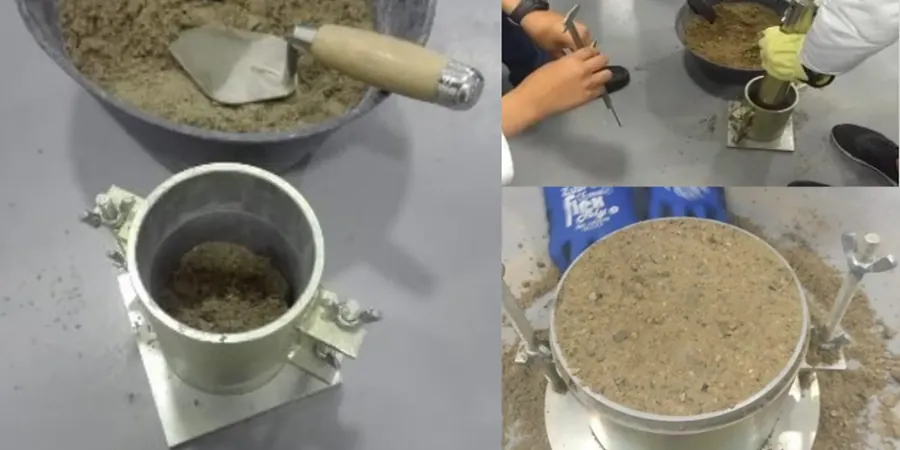
Longueuil’s subsoil conditions are dominated by the Champlain Sea deposits, a legacy of post-glacial inundation that left thick sequences of sensitive marine clay and silty till across the South Shore. On sites near the Saint Lawrence River, natural moisture content often exceeds the optimum, which makes compaction specification unachievable without precise laboratory correlation. The Proctor test establishes that relationship between dry density and water content, giving contractors a target that actually reflects the borrow material they will place. Whether structural fill beneath a slab in Greenfield Park or roadway embankment in Vieux-Longueuil, standard (ASTM D698) and modified (ASTM D1557) efforts simulate different compaction energies so the design matches the intended traffic or structural load. Before importing fill, it is common to run a companion grain size analysis to confirm fines content, because clay-rich soils from the La Prairie basin respond very differently than the clean sands found near Boucherville.
In Longueuil’s Champlain Sea clays, a 2% deviation from optimum moisture can cut dry density by over 5%, compromising bearing capacity before the structure is even framed.
Local considerations
The compaction hammer assembly—whether the 5.5 lb standard or 10 lb modified rammer guided by a steel tube inside a rigid mold—looks simple, but the data it produces becomes legally binding in Longueuil municipal inspections. If field density tests fall below 95% of the laboratory maximum dry density, the city inspector can issue a stop-work order until the failed lift is scarified, moisture-conditioned, and recompacted. On silty clay sites along Taschereau Boulevard, the real risk is reusing excavated material that tested well in the lab but gets rained on during stockpiling; its moisture drifts past optimum overnight and the same soil suddenly fails density checks. A new Proctor must be run if the borrow source changes or the gradation shifts visibly, because the curve is unique to that specific material blend.
Frequently asked questions
How much does a Proctor test cost in Longueuil?
A single-point Standard or Modified Proctor test typically ranges from CA$160 to CA$310, depending on whether it is a full five-point curve or a single-point verification. The total cost varies with the number of material types on site and whether companion classification tests like grain size or Atterberg limits are requested.
Which Proctor method is required for residential foundation backfill in Longueuil?
Most municipal permits on the South Shore accept the Standard Proctor (ASTM D698) for residential foundation backfill, provided the structural fill is a clean granular material. If the engineer specifies a higher compaction level due to sensitive Champlain clay, the specification will explicitly call out ASTM D1557 Modified Proctor.
How many material samples are needed for a valid curve?
A full moisture-density curve requires a minimum of four to five points spanning the expected optimum moisture range. The laboratory uses the same material passing the designated sieve, remixed at increasing water contents, and compacted into separate molds to generate a reliable parabola with a clearly identifiable peak.
What is the typical turnaround time for Proctor results?
Standard turnaround is 24 to 48 hours after the sample arrives dry and bagged. Expedited same-day results are available when the contractor needs a target density before morning placement, provided the sample is delivered early and the lab is notified in advance.