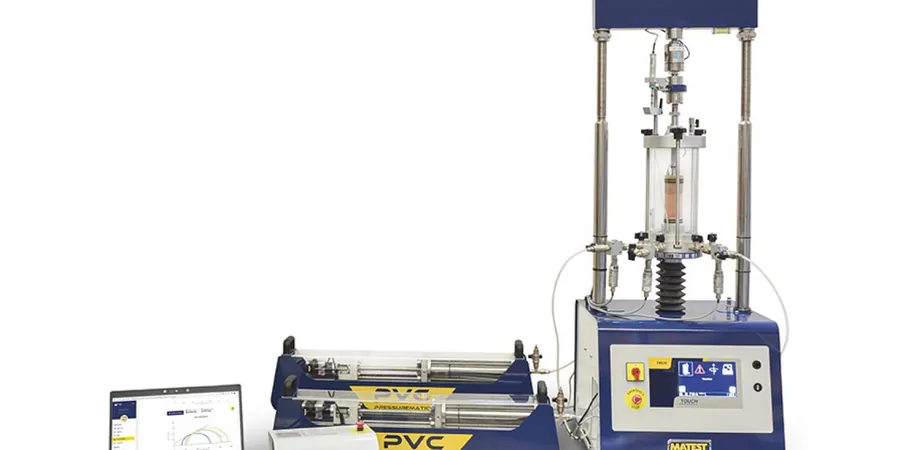
The 2020 National Building Code of Canada (NBCC) mandates a thorough geotechnical investigation for any structure falling under Part 4. In Longueuil, this isn't just a bureaucratic step. The city sits on the sensitive Champlain Sea clay deposits, where undisturbed sampling and precise strength testing make the difference between a stable foundation and a costly failure. A standard investigation often stops at index properties, but for deep excavations along the Saint Lawrence River's south shore or embankments near Parc Michel-Chartrand, the triaxial test provides the constitutive parameters that empirical correlations simply cannot capture. When the CPT test reaches refusal on a silty lens, or test pits reveal the oxidized crust thickness, the triaxial cell takes over to simulate the actual stress path the soil will experience under load.
A triaxial test on Longueuil's intact Champlain clay often shows an apparent preconsolidation pressure well above the current overburden, a remnant of the vanished Champlain Sea.
Frequently asked questions
How much does a triaxial test program cost for a Longueuil site?
A triaxial test series (typically 3 specimens for a Mohr-Coulomb envelope) ranges from CA$2,580 to CA$3,940, depending on whether we run UU, CU, or CD protocols. The final cost depends on the number of Shelby tubes we need to extrude and the consolidation stress range you require for your foundation depth.
What makes Longueuil's clay so sensitive that a triaxial test is necessary?
The Champlain Sea clay is a quick clay in many zones. Its structure is held together by salt leaching from the marine deposit. When sheared undrained, the peak strength can be three times the remolded strength. A triaxial test captures this strain-softening behavior that a simple vane shear test might miss.
How do you ensure the sample is not disturbed before testing?
We use thin-walled Shelby tubes and transport them with vibration dampeners from the drill rig to our lab. Extrusion is done in a humidity-controlled room at constant temperature. We measure the initial suction and run a B-check during saturation to verify the specimen's structure remains intact before shearing.
Can you run a triaxial test on samples with sand or silt seams?
Yes. For specimens with silty interbeds common in Longueuil's transitional zones near the river, we can trim 70 mm diameter specimens. We also install filter paper side drains to accelerate consolidation, per ASTM D4767 recommendations for soils with minor sand content.
How long does a consolidated drained triaxial test take?
A CD test on Longueuil clay takes anywhere from 5 to 14 days per specimen. The consolidation phase itself can take 48 hours, and we shear at a rate calculated from the coefficient of consolidation. This slow rate ensures we truly measure drained strength, not an intermediate partially drained state.