← Home · Investigation

SPT (Standard Penetration Test) in Longueuil: Reliable Subsurface Data for Foundation Design

Together, we solve the challenges of tomorrow.

LEARN MORE →

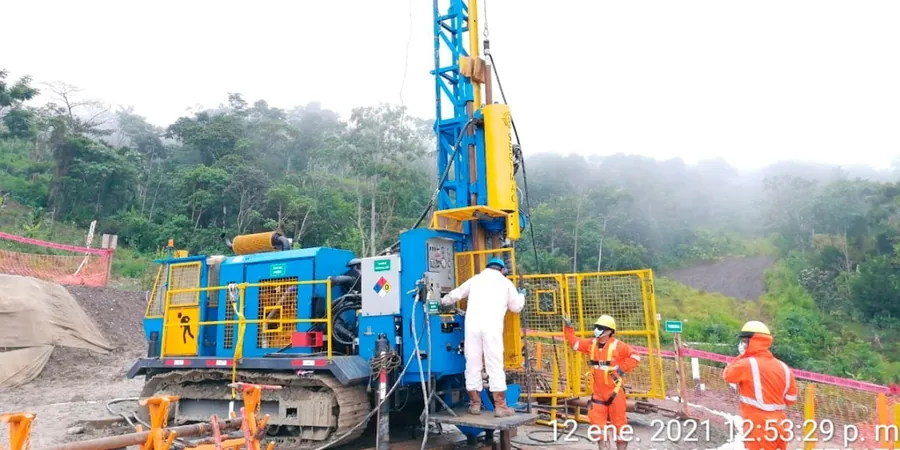
The St. Lawrence Lowlands define Longueuil's subsurface, where soft Champlain Sea clays grade into dense glacial till at variable depths, often within 10 to 18 meters of grade. This transition zone creates abrupt bearing capacity contrasts that standard desk studies miss, making the Standard Penetration Test the most practical first-line investigation method across the South Shore. Our team deploys track-mounted SPT rigs to sites from Vieux-Longueuil to Saint-Hubert, executing ASTM D1586-18 procedures while logging each 18-inch split-spoon drive for moisture, gradation, and consistency changes. Because Longueuil sits within NBCC seismic zone 5 with a Site Class C to E range depending on clay thickness, raw N-values must be corrected for overburden pressure and energy ratio before any liquefaction assessment or bearing capacity calculation is attempted.

Corrected N60 values in Longueuil's Champlain clay typically range from 4 to 18, but ignoring overburden correction at depths beyond 12 meters can overestimate bearing capacity by 30 percent.

Methodology and scope

Winter freeze-thaw cycles in Longueuil penetrate up to 1.5 meters, saturating the upper clay crust each spring and temporarily reducing blow counts in the first 3 meters of boring. This seasonal softening means SPT data collected in April and May often under-predict the true summer bearing capacity of stiff silty clay layers unless the driller records groundwater level at the time of testing. We run continuous SPT sampling at 1.5-meter intervals through the weathered crust and into competent till, then cross-reference field N-values with grain-size analyses on split-spoon samples to confirm whether refusal is on boulders or bedrock. When encountering sensitive Leda clay below the water table, we slow the hammer drop rate and use thin-walled sampler liners to preserve sample structure, because remolding during extraction destroys the undrained shear strength signature that governs slope stability analysis. For projects near the Saint-Lambert escarpment where till overlies shale at shallow depth, we combine SPT refusal depths with seismic-refraction profiles to map bedrock topography without over-drilling.
SPT (Standard Penetration Test) in Longueuil: Reliable Subsurface Data for Foundation Design
Technical reference image — Longueuil

Local considerations

Boreholes advanced through Longueuil's desiccated clay crust without temporary casing can collapse within hours if the water table rises during drilling, trapping the sampler and losing the hole. We see this most often in late autumn when rain recharges the perched aquifer above the Champlain clay aquitard. Another common pitfall is mistaking sand seams within the clay for a competent bearing layer — these thin lenses often liquefy under seismic shaking and provide no lateral confinement for deep foundations, a risk that only becomes apparent when SPT blow counts spike for one interval then drop to zero in the next. For sites within the Ville-Marie fault zone influence corridor, we always log drill water loss and sudden rod drops as indicators of fissured rock or karst cavities, because the Saint-Michel limestone formation under Longueuil's eastern sectors can contain solution-widened joints that swallow foundation grout.

Need a geotechnical assessment?

Reply within 24h.

Email: contact@geotechnical-engineering.org

Technical parameters

ParameterTypical value
Test StandardASTM D1586-18 / CSA A119.1
Hammer TypeSafety hammer (cathead + rope) or automatic trip
Energy Ratio (Er)45–70% — measured per blow with instrumented rod cap
SamplerStandard 2-inch OD split spoon, 18-inch drive
Sampling Interval1.5 m continuous or every change in stratum per driller log
N-Value CorrectionCN (overburden), CE (energy), CB (borehole diameter), CR (rod length)
Applicable Seismic CodeNBCC 2020, Section 4.1.8 — Site Class determination via N60
Reporting OutputBoring log with N, N60, (N1)60, soil description, and groundwater depth

Associated technical services

01

Track-Mounted SPT Drilling

Continuous flight auger or mud-rotary SPT borings to 25 meters depth, with automatic trip hammer and energy calibration on every rod string. Suitable for tight access in Longueuil's residential neighborhoods.

02

Seismic Site Classification Package

N60-based Site Class determination per NBCC 2020 Table 4.1.8.4.A, including liquefaction screening using the Seed-Idriss simplified procedure for SPT data in sand layers.

03

Bearing Capacity and Settlement Analysis

Allowable bearing pressure for shallow footings from corrected N-values using Meyerhof and Bowles methods, with immediate settlement estimates on granular soils and consolidation settlement on Champlain clay.

Applicable standards

ASTM D1586-18: Standard Test Method for Standard Penetration Test (SPT) and Split-Barrel Sampling of Soils, NBCC 2020: National Building Code of Canada — Seismic Site Classification via N60 and Vs30, CSA A23.3-19: Design of Concrete Structures — Foundation bearing capacity from SPT data, ASTM D2488-17: Description and Identification of Soils (Visual-Manual Procedure) for sample logging

Frequently asked questions

How much does an SPT boring program cost in Longueuil?

For a typical residential project requiring two boreholes to 15 meters depth with full N-logging and laboratory index testing, the total investment ranges from CA$690 to CA$1,130 per borehole depending on access, depth, and the number of samples sent for grain-size and Atterberg limits. Mobilization within the South Shore is included in the unit rate. Projects requiring more than five boreholes or deeper drilling into till may qualify for volume pricing.

How do you correct SPT N-values for Longueuil's soft clay and what does N60 mean?

Raw field N-values are corrected to N60 by normalizing the hammer energy to 60% of theoretical free-fall energy, then to (N1)60 by applying an overburden correction factor (CN) that accounts for vertical effective stress at the test depth. In Longueuil's Champlain clay, where undrained shear strength controls bearing capacity, we use the Liao & Whitman (1986) CN relationship and report both N and N60 on every boring log so the design team can select appropriate correction factors for their analysis.

What depth do SPT boreholes need to reach for a typical single-family home in Longueuil?

The NBCC requires investigation to a depth where the stress increase from the foundation is less than 10% of the in-situ effective stress, which for a typical two-story home on a 0.9-meter-wide strip footing translates to approximately 10 to 15 meters below grade in Longueuil. If the SPT encounters dense till or bedrock at shallower depth, the boring may terminate at refusal provided the driller logs the refusal depth and hammer bounce behavior for the geotechnical engineer to review.
Location and service area

We serve projects across Longueuil and its metropolitan area.

View larger map